Paper Sketches or Loose Word Lists?
Paper sketches or loose word lists help you develop an idea: choose the format that makes its structure or language easier to compare and carry forward.
The common mistake with paper sketches or loose word lists is choosing the format that looks more finished, then mistaking its first result for a strong idea. That can hide what you still need to work out: a clean drawing may conceal a weak sequence, while a tidy list may disguise a set of disconnected terms. Choose a format for what it lets you compare, not for how polished the page looks.
A sketch gives form to position, shape, and sequence; a loose list lets you compare names, tones, and associations. The distinction is not visual versus verbal talent. It is whether the idea needs to be arranged on the page or sifted through language.
Sketches Show Structure
Use a pencil, scrap paper, and simple marks when your idea involves parts that must fit together or events that unfold in an order. Boxes can stand for objects or scenes, arrows for movement, and labels for pieces you have not decided how to draw. A few rough frames can reveal a missing transition more clearly than a paragraph describing it.
Sketches can also mislead. A convincing shape may make a solution feel settled before you have considered what it needs to do. Keep uncertain parts visibly open with question marks, dotted lines, or multiple rough alternatives.
Lists Compare Language
Use a loose word list when the idea depends on meaning, tone, or the names people might use for it. Write fragments rather than full explanations: “borrowed,” “nearby,” “quiet signal,” or “too formal.” On separate lines, these phrases are easy to rearrange, cross out, or pair without committing to a finished sentence.
A list can also flatten distinct possibilities into a cluster of similar words. If several entries mean nearly the same thing, add a contrasting term or a concrete phrase that shows what each one might imply.
Choose by the Work
Start with a sketch if you need to see where parts go, how someone moves through a space, or what changes between moments. Start with a list if you need to compare possible names, themes, or tones. If the idea calls for both, use the first page to clarify one kind of decision, then switch formats to examine the other.
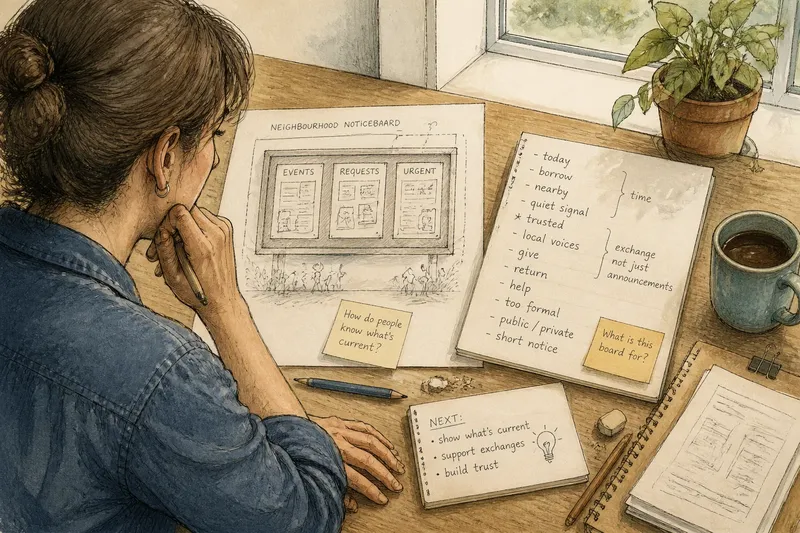
Imagine you are planning a neighborhood noticeboard, and your starting notes say only that residents need to share local information. You sketch a board with spaces for events, requests, and urgent notices; the layout makes the categories visible, but leaves unclear how people would know which notice is current. You then list “today,” “borrow,” “nearby,” and “trusted,” and the terms suggest that the board may need to support exchanges as well as announcements. The tradeoff is clear: the sketch exposes a layout question, while the list opens a broader question about what the board is for.
Make a Quick Comparison
Try one short pass in each format, then use what you can actually see on the pages to choose a direction. Treat each result as a provisional clue, not a verdict.
- Observation: the sketch shows a gap between two parts; if the gap represents a missing action, add a frame or arrow, then see whether the sequence reads more clearly. If it does not, revise the order instead.
- Observation: several list entries have nearly the same meaning; if you need distinct options, add a contrast such as “private” beside “public.” If the distinction is not useful, cross out the duplicates.
- Observation: the drawing looks finished but relies on an unexplained assumption; if that assumption affects the idea, mark it with a question mark and sketch an alternative. If it does not, keep the drawing provisional and move on.
- Observation: the list captures a tone but says nothing about how the idea works; if the process matters, turn one phrase into a rough sequence of boxes. If it does not, keep comparing language.
- Observation: both pages point to the same unresolved choice; if you can name that choice, develop the page that makes it easier to compare. If you cannot, write the competing options beside the pages before choosing a format.
- Observation: neither page contains a detail you want to pursue; if the prompt is too broad, narrow it to one person, moment, or decision. If the prompt is already specific, change formats and look for a different kind of clue.
What Should You Use?
Can I sketch if I cannot draw?
Yes. Use circles, boxes, arrows, stick figures, and labels to show relationships; the marks only need to make sense to you.
What if no words come to mind?
Write an imperfect phrase, a sensory detail, or an opposite of what you expect. “Too loud,” for example, gives you something concrete to revise instead of waiting for a polished description.
Should I combine both formats?
Combine them when each has a distinct job: add labels to show what belongs in a sketch, or draw a small symbol beside a word cluster. If the additions only decorate the page, return to one format.
When should I stop exploring?
Pause when you can point to a specific feature you want to develop, such as a relationship in the sketch or a contrast in the list. If you can only say that the page looks promising, identify what you still need to clarify.
Carry One Detail Forward
Compare the pages by what each made easier to inspect, not by neatness or completeness. A sketch might reveal an arrangement worth changing; a list might expose two meanings that should not be treated as interchangeable.
Take one useful detail into a fresh page rather than trying to preserve every mark. A word pairing can become two rough layouts, or one arrangement can prompt a short list of possible contents. For paper sketches or loose word lists, that switch is useful when it helps you make a clearer next choice, not because every idea needs both formats.
Before setting the page aside, note the specific detail you want to examine next. That keeps the thread visible while leaving room to change direction.