The Old Scrapbook as a Place to Think
Use an old scrapbook as a thinking tool: preserve where fragments came from, arrange them to test a question, and turn useful tensions into new directions.
The common mistake with an old scrapbook is treating it as a source of ready-made inspiration; the cost is a stack of attractive clippings that says little about what to do next. Use an old scrapbook as a thinking tool instead: preserve the circumstances around each fragment, then change those circumstances on the page to explore a question.
Set a working boundary
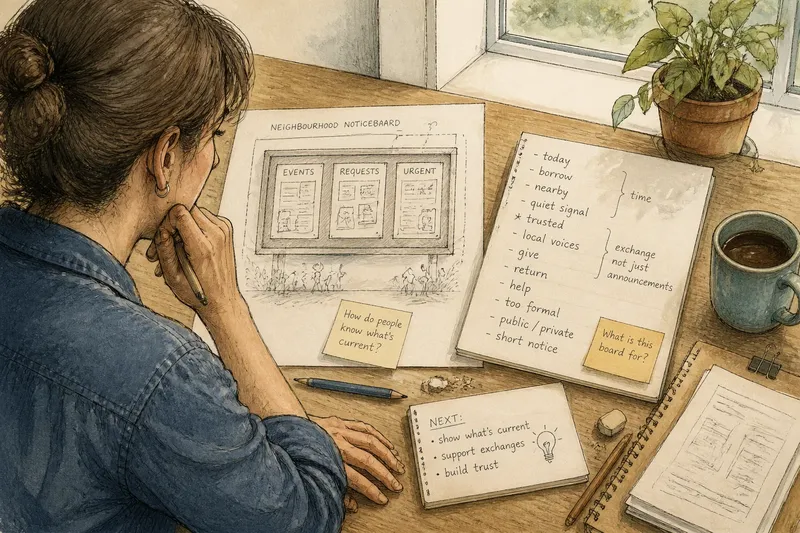
Give the scrapbook a limited subject and a boundary for what belongs. For instance, you might explore how a neighborhood noticeboard can help someone find the right information without already knowing the group that posted it. That boundary keeps the collection focused on orientation and access, rather than on every appealing image of community life.
Write the question on a removable card and keep it beside the open page. Add a few words about what falls outside the inquiry, such as event promotion or decoration, so you can recognize when a fragment is merely attractive rather than relevant.
Record each fragment’s origin
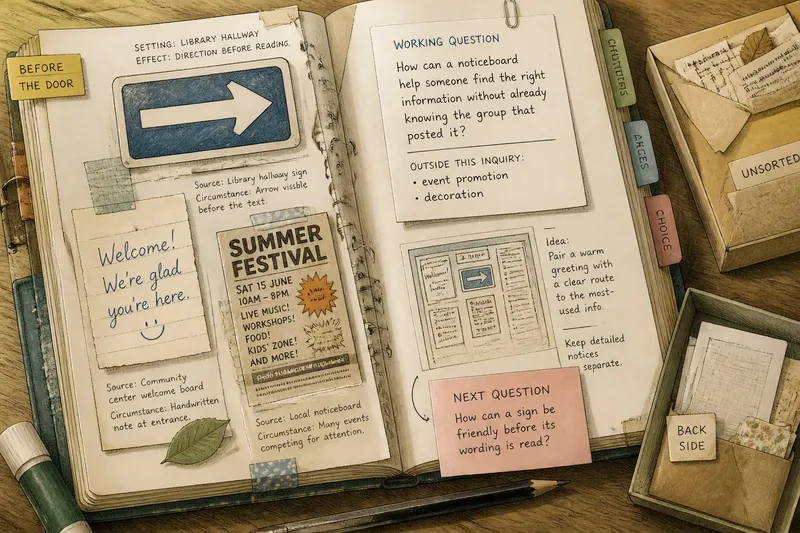
Gather a scrapbook or blank notebook, pencil, paper tabs, glue stick, and envelopes for loose pieces. For each clipping, sketch, phrase, or found texture, jot down its source and the circumstance that caught your attention. A note might read, “Library hallway sign; arrow visible before the text.” That information lets you revisit the fragment as a response to a setting, not just as a shape or color.
If you cannot keep the original, draw it or describe its useful features. Do not remove material that belongs to someone else or is not yours to take. Before sharing published images or photographs beyond private exploration, check the applicable permissions.
Build pages around situations
Instead of sorting fragments into broad categories such as “type,” “color,” and “people,” make each page about a situation in which the material has meaning. A page could collect things a visitor sees before reaching a doorway, while another could hold signs that make a choice feel easier or harder.
Keep the original item and its context together. If a clipping has useful information on the back, put it in a pocket rather than gluing it down. Add a small caption that names the setting and the effect you noticed, leaving room for the effect to be reconsidered.
Compare contexts, not appearances
When two fragments seem related, ask whether they work under similar conditions. A large arrow on a hallway wall and a tiny arrow on a folded map may share a shape but serve different moments: one catches attention at a distance, while the other helps someone already reading closely.
Write down the condition that makes each fragment useful. Try prompts such as “visible before the decision,” “readable while moving,” or “helpful without staff nearby.” These phrases can lead to design questions without turning the scrapbook into a catalog of styles.
Say you are exploring a noticeboard for a community center, and your hypothetical starting materials are a handwritten welcome, a library hallway arrow, and a crowded event flyer. You note that the welcome sounds personal, the arrow gives a clear direction, and the flyer competes for attention. You place them together and ask whether a board could pair a warm greeting with a distinct route to the most-used information; the resulting direction is to explore a clear entry point while keeping detailed notices separate, not to copy any single item.
Use a page review
Before adding another fragment, review the page for evidence about its usefulness. Check each item and make a decision based on what you observe:
- Check whether the source and setting are recorded; if both are clear, keep the fragment in the working group, but if either is missing, add a note or move it to an uncategorized pocket.
- Check whether the fragment relates to the working question; if the connection can be stated in one plain sentence, keep it on the page, but if not, move it aside without discarding it.
- Check whether the page contains more than one kind of situation; if it does, compare those situations, but if every item comes from the same context, seek a contrasting source or mark the narrow scope.
- Check whether two items serve the same purpose in different ways; if they do, write down the difference, but if they only look alike, separate them and record the visual resemblance as a weaker link.
- Check whether a fragment has useful information on its reverse; if it does, use a pocket or folded tab, but if it does not, attach it lightly so it can still be moved.
- Check whether the page suggests a next question; if it does, write that question on a removable card, but if it does not, leave the page open and gather material from a different setting.
Where does the scrapbook help?
How do you prevent a scrapbook from becoming cluttered?
Keep a fragment only if you can record its source, the circumstance that matters, or a question it raises. If you cannot name any of those, place it in a separate pocket until a connection becomes clearer.
Should you attach everything permanently?
No; use pockets, paper tabs, or light pencil marks while the arrangement is still changing. Attach an item only when its position helps you understand a relationship, and preserve any useful back side.
Can a digital collection serve the same purpose?
A folder in a note-taking app or a board in a visual-organizing app can preserve images, source links, and captions. Keep the original context with each item, and use a physical page when texture, scale, or the act of rearranging matters to the question.
How can you tell when a page has become useful?
You can point to a relationship among specific fragments and state what condition makes that relationship relevant. If the connection depends only on a vague mood or resemblance, treat it as a prompt for another question rather than a direction to develop.
Carry forward a question
When a page suggests a new direction, copy the question or relationship onto a fresh card and leave the page intact. For example, “How can a sign be friendly before its wording is read?” is a more useful next inquiry than “Use a warm color,” because it keeps attention on the situation and leaves several approaches open.
The old scrapbook is most useful when it records why a fragment mattered in its original setting and what changed when you placed it beside something else. For the next round of idea development, carry forward one specific relationship and the condition that made it interesting; that keeps the new work connected to the evidence on the page without treating an early impression as a finished answer.