The First Idea Is Not Always the Best Fit
The first idea is not always the best fit. Use concrete criteria and a contrasting draft to see which direction serves your audience and project.
The common mistake with a first idea is treating its arrival as proof that it belongs in the finished work. For a creative project, that can cost you a useful direction: you may polish an appealing concept before noticing that it misses a practical need.
Instead of asking whether the idea is good in the abstract, identify what the work must help someone do, understand, or feel. Then check the idea against that job and make a contrasting draft only if it exposes a real trade-off.
Name the decision
Write down the decision your project needs, not a broad question that could lead anywhere. A neighborhood garden sign, for example, may need to tell a first-time visitor where the entrance is and where to begin.
Record the first idea in one plain sentence, such as “Use a flower-framed welcome slogan.” Keep it as a candidate. This makes it easier to inspect what the idea actually communicates rather than defend the excitement of having thought of it.
Set useful criteria
Choose criteria that follow from the project’s purpose. For a sign, clarity and audience fit may matter more than novelty; for an experimental poem, surprise and tone may matter more than giving instructions.
Use the same criteria for each direction, and state what you would observe before choosing. A simple note beside each item is enough:
- Purpose: Check whether the direction answers the project’s stated need; if it does, keep it in consideration, but if not, revise or set it aside.
- Audience: Check whether the intended reader can understand the message without extra explanation; if yes, retain the wording, but if not, simplify it or add context.
- Clarity: Check whether the main action or idea stands out in a rough draft; if it does, preserve that hierarchy, but if not, rearrange or reduce competing details.
- Tone: Check whether the voice suits the setting and subject; if it does, keep the approach, but if not, adjust the language or imagery.
- Practicality: Check whether you can make the idea with the available materials, time, and skills; if yes, develop it, but if not, simplify the design or choose another direction.
- Distinctiveness: Check whether the idea adds a useful perspective rather than repeating a familiar solution; if it does, keep exploring it, but if not, change its central choice or accept the familiar approach when it best serves the purpose.
Do not treat every criterion as equally important. Mark the one that matters most to this project before comparing drafts, so visual polish or personal preference does not quietly decide the result.
Make a meaningful contrast
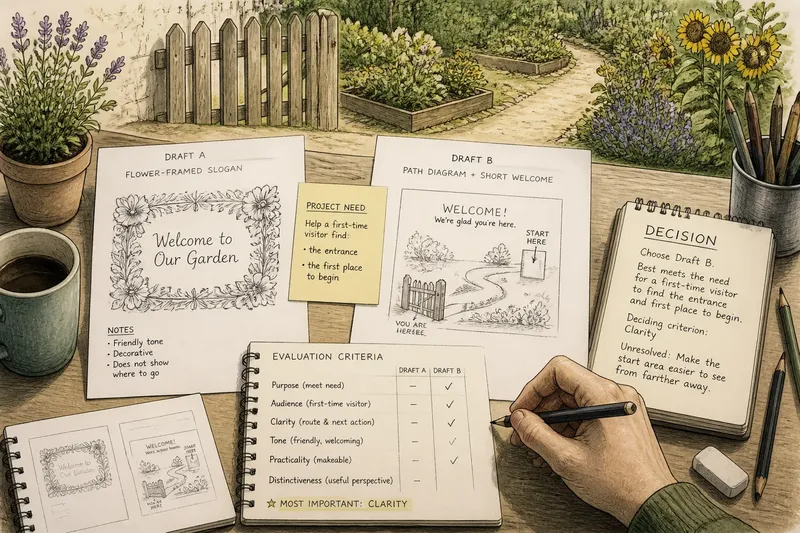
A contrast should change the central approach, not just the color, font, or decoration. If the first direction for a garden sign is a flower-framed slogan, a contrasting draft could use a simple path diagram with a short welcome line.
Keep both versions rough. Pencil sketches, index cards, or a quick layout in Canva are enough to compare what each makes easy to notice. You are looking for a difference in usefulness, not a more finished presentation.
Compare observable results
Look at each draft beside the criteria and write what a reader could actually see or do. “The path diagram points to the open gate” is more useful than “This one feels stronger.” If a draft needs explanation to make its purpose clear, record that as an unresolved issue.
Say you are making a welcome sign for a small neighborhood garden. Your starting inputs are a flower-framed slogan as the first idea, a visitor who has never been there, and the need to show the open gate and first place to begin. You sketch that slogan, then make a contrasting pencil draft with a path diagram and a short welcome line; comparing the two against clarity, tone, and practicality shows that the diagram makes the route and next action visible while still feeling friendly, so it fits this brief better, though the slogan could remain as supporting text.
Questions about first ideas?
What if the idea feels obvious?
Obviousness alone is not a reason to reject it. Check whether it serves the audience and purpose; if it does, keep it as a candidate and develop a rough draft before polishing.
When should I make an alternative?
Make one when the first idea leaves a stated need unclear, relies on a familiar solution that may not fit, or seems to favor one criterion at the expense of another. If the first draft already meets the project’s main need and is easy to revise, an alternative may add little.
What if both directions seem strong?
Identify the criterion that is still uncertain, then make a small revision that lets you compare that specific quality. If the difference does not affect the project’s purpose, choose the direction that is simpler to develop and keep it revisable.
How do I avoid choosing by personal taste?
Write down the project’s main criterion and point to an observable feature in each draft. If a preference has no connection to the audience or purpose, treat it as a secondary consideration rather than the deciding reason.
Keep the reason visible
When you choose, note the deciding criterion and any unresolved concern beside the draft. That brief record helps you explain the choice to collaborators and revisit it if the project’s needs change.
For useful feedback, show the drafts with the project need and ask about the criterion still in doubt. A focused question such as “Can you tell where the entrance is?” gives people something specific to assess instead of inviting a general vote on which design they like.
The first idea is not always the best fit, but it may still be the right choice. Compare it with a meaningful alternative when a real decision remains, and let the project’s most important need—not the idea’s age or polish—settle the choice.